
About the Whippany Melosonic / Realistic Musideck combo organ
Need help with your Whippany Melo-sonic or Realistic Musideck? Ask the Wurly Hotline.
See more notes on a Realistic Musideck that we previously had in the shop.
The Realistic Musideck is a compact transistor combo organ dating to the 1960s. It was built in Italy and sold under various names in the United States, including the Whippany Melo-Sonic. Variants include the Melo-Sonic Model 300 and Model 350.
We love the Realistic Musideck due to its lightweight build, cool combo organ tone, and quirky intonation. In this article, we’ll tell you how we tune a Realistic Musideck and clean its contacts for reliable performance.
What is a Realistic Musideck?
This little combo organ goes by a few names, depending on who sold it. That's right: the same organ was made in one place, and branded with a different name for different resellers. It could be called a Realistic Musideck if sold under RadioShack’s Realistic brand, or a Whippany Melosonic if sold by the Whippany Melo-sonic Corporation.
Inside, you’ll find a stamp stating 'Made in Italy.’ So, regardless of what the exterior stamps claim (often they say made in USA on the exterior...), the circuits and keyboard at the very least were made in Italy. It is likely that the factory was located in the Marche region. These instruments were probably not made in vast quantities, because not many are still around today.
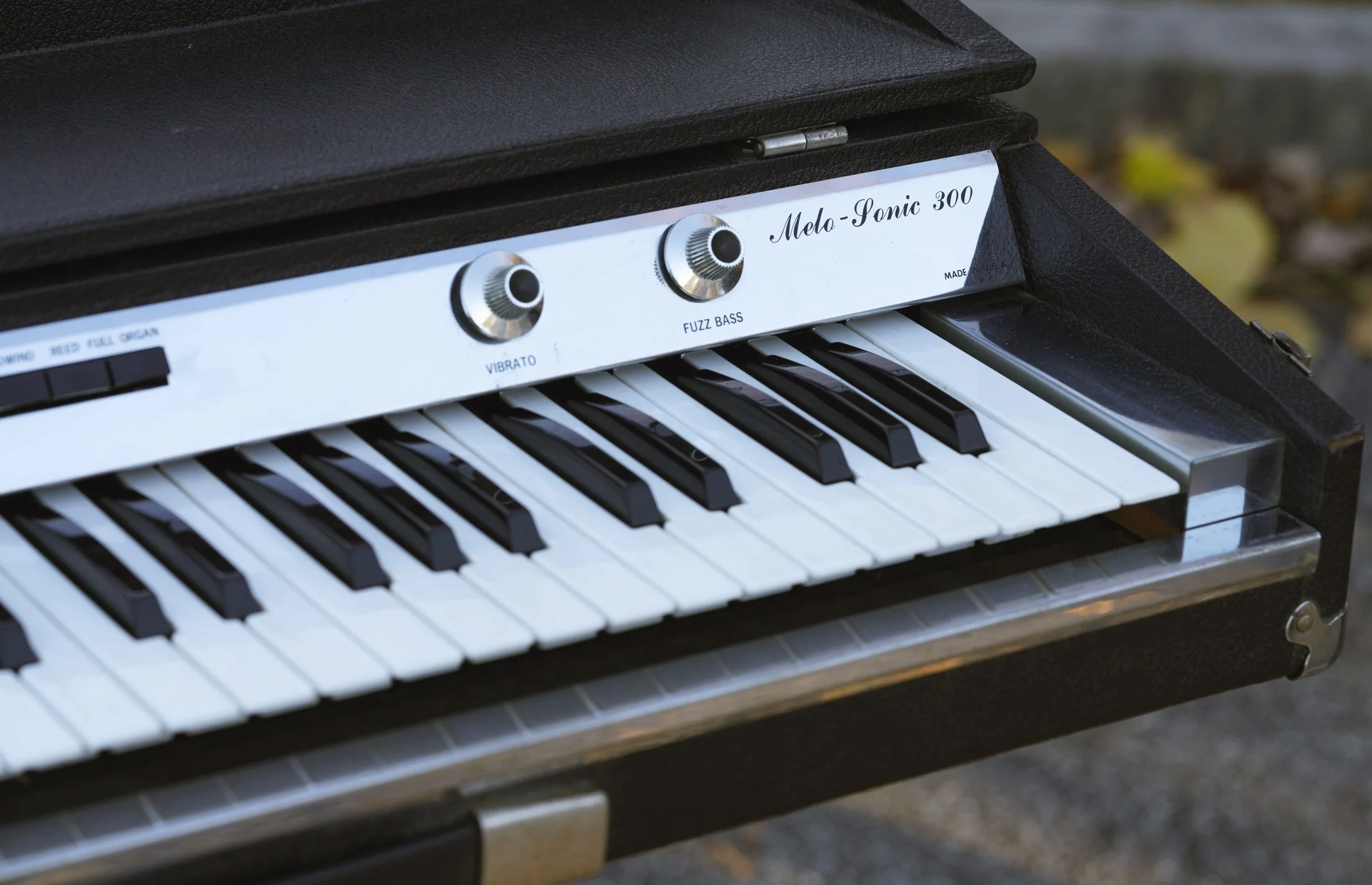
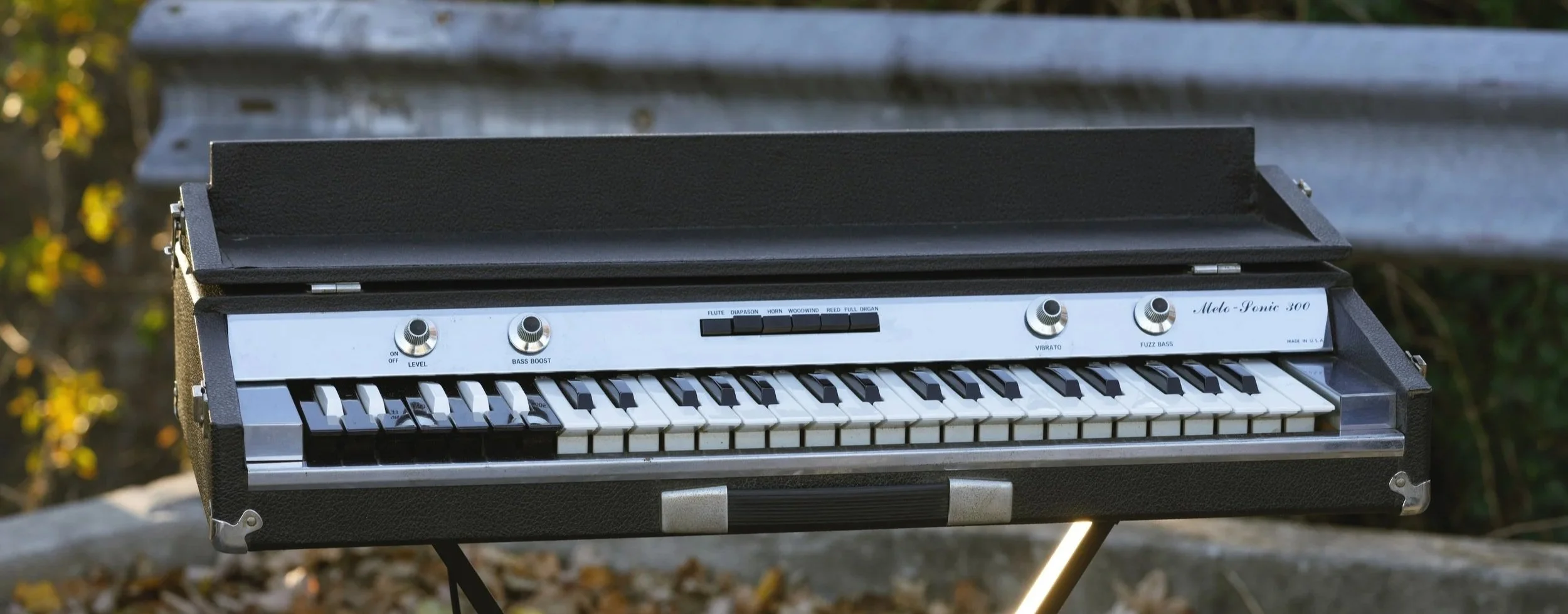
The Melo-Sonic 300 has Vibrato and Fuzz Bass controls on the right…
All models that we have seen do have a vibrato control, and also all have independent control over the bass volume. The voice selections include Flute, Diapason, Horn, Woodwind, Reed, Full Organ. These selections are essentially equalizers.
The Melo-Sonic’s 1/4” output can be easily connected to any guitar amplifier, opening up plenty of tonal possibilities. It works well with many effects pedals, which can be mounted on the flat top of the case for easy access. It does not have a power amplifier or onboard speaker.
Repairing a Melo-Sonic/Musideck
Although the Musideck’s circuit is extremely basic and the overall design is prone to quirks, it can be restored to a baseline level of reliability. It has a great sound that cuts through a mix very well, and a musician who is familiar with its idiosyncratic action can do a lot with it. Norah Jones, for instance, has used a Realistic Musideck in live performance.
Furthermore, because the Melo-Sonic/Musideck does not have an onboard speaker, there are very few power-handling components in the amplifier. Although we are always a fun of an onboard speaker, the lack of power amp does eliminate a lot of complexity, and makes the vintage circuit that much more reliable.
Important safety note: Although tuning the Melo-Sonic and cleaning its contacts is straightforward in theory, the keyboard must be powered on and connected to mains power in order for you to do so. This exposes you to hazardous voltages and adequate safety precautions must be taken. Do not attempt these repairs unless you are qualified to do so. A full discussion of electronics safety information is outside the scope of this article.
Tuning a Melo-Sonic
The keyboard contains multiple electronic oscillators, each one setting the pitch for a consecutive group of notes. The upper most trim pot will tun the top four notes. Each successive trim pot working your way down the keyboard will tune three notes. Finally, the second to lowest trim pot will tune all of the reverse color bass notes. (The last trim pot on the left sets the tremolo intensity).
If the trimpot can’t accurately set the pitch, then the note’s precision tuning resistor has drifted and must be replaced. We use the following procedure to tune drifted notes in the Melo-Sonic.
Starting with the highest-pitched oscillator, cut each intonation resistor. Clip the leads very close to the body of the resistor, so that they can be used as posts for clipping test leads onto. Connect the test leads to a decade box.
Connect the test leads to a decade box, and adjust the controls until the note plays the correct pitch. If you do not have a decade box, you can substitute different resistor values in series and parallel until you achieve the correct pitch experimentally. Pro tip: the resistor value is usually something between 100 Ω and 2 kΩ.
When you determine the correct resistor value, clip a resistor in place temporarily, and write down its value. You must clip the resistor into place because the lower notes in the set will not play unless the intonation resistors for the upper notes are present.
Work your way down the keyboard until you have found an acceptable resistor for all notes. To avoid a lot of back-and-forth between installing and testing values, I use a lot of jumper wires and use the decade box to determine each resistor value before installing everything in one batch.
Some Melosonic keyboards either came [or were at some point outfitted] with small individual trim pots for every note, in place of the intonation resistor. This is nice, but trim pots are prone to movement, and this may require more regular tuning attention (after traveling, moving the keyboard around, etc). I personally prefer the ruggedness of a fixed resistor. Once they are replaced, their values should hold for several years.

…and the Realistic Musideck has its Vibrato control on the left.
Note that effective tuning requires a wide range of 1/2 watt resistor values. Although our resistor stock is pretty comprehensive, and we still often have to tie resistors together in parallel or series to get just the exact value we need. Being off by ± 2–5 ohms is usually enough to make a note not quite in tune.
Some players expect a degree of "quirkiness" from these keyboards, and inaccurate tuning can certainly be counted as a quirk. However, I can say from experience we have done some very solid tuning jobs on these, and still felt there was plenty of quirkiness to go around.
Part of the "quirkiness" is due to the design of the key contacts, and how they have a tendency to give each note a 'rubbery' attack, almost like tube sag. This brings me to another maintenance tip—cleaning the contacts!
Cleaning & adjusting the contacts
The contacts on this instrument are two wires (often called J-wires) and the mechanism works well, but requires cleaning periodically. In a neglected instrument, it is very common for the contacts to be completely oxidized. Some symptoms of oxidized contacts include:
the note does not play at all
the note squeaks in-and-out intermittently
the note plays at an unintended pitch
The top wire has a bend to it, and the lower wire is lifted by the key to touch the top wire. Sometimes the top wire's bend needs to be increased, as it can have a tendency to flatten out over time and lose its strength. Gently adding additional bend can be a great way to revive a weak contact.
If the contacts are oxidized, the connection will be unreliable. The contacts can be cleaned with contact cleaner or isopropyl alcohol. If the contacts are heavily oxidized, a lightly abrasive pad can be used. To avoid damage, be very judicious with any cleaning technique that tends to remove material.
With a thorough cleaning, the contacts will be back to their rubbery-sounding selves.
Wurly legs?
All of the portable versions of this keyboard have chrome legs. These legs are look very similar to Wurlitzer electronic piano legs, except that the Melo-Sonic foot is plastic instead of metal. So, not only does the Melo-Sonic share the cool chrome aesthetic of a Wurlitzer 200A, new legs can be obtained if the originals were lost. Unfortunately, the Melo-Sonic leg bolt is a different size, so installing Wurlitzer legs requires that trading the original leg plate for a Wurlitzer leg plate.
Another fun thing about the Melo-Sonic legs is that they can be mounted underneath the case for on-the-go use. Unfortunately, Wurlitzer legs are just slightly the wrong dimensions to fit in the original leg holder. However, it may be possible to adjust the mount to accommodate Wurlitzer legs.
We have heard of console versions of this organ, which are on a classic console organ cabinet instead of the chrome legs. We love the sound, so we’ll be on the lookout!
