
What makes the Tropical Fish M3 Preamp special
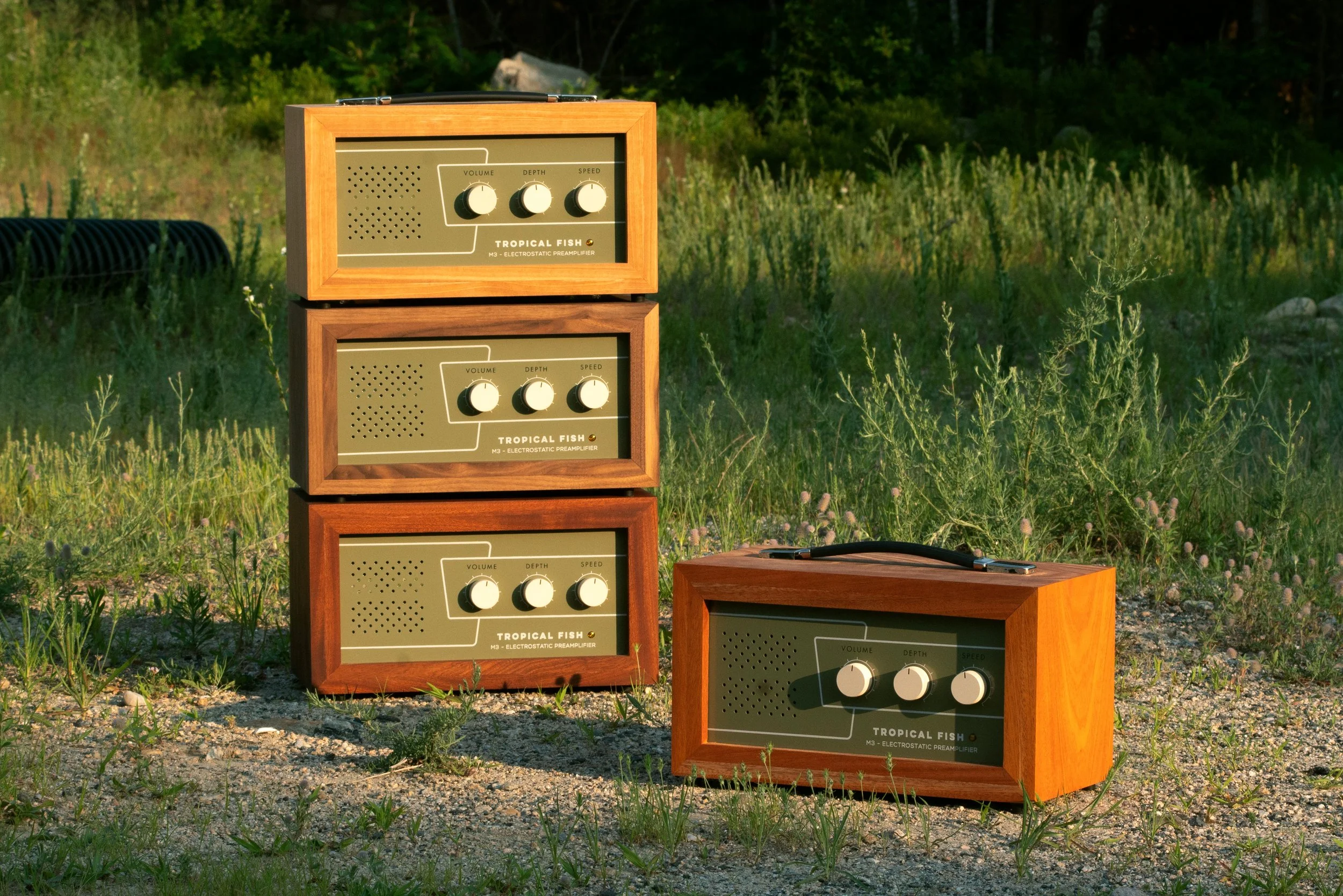
All four of the wood types we currently use, Mahogany, Honduran Mahogany (limited), Anigre (limited), Walnut.
You may know already that, when we started making this preamp, it was so we could have a great-sounding way to power a Wurlitzer pickup. By that, I specifically mean add voltage to the Wurlitzer electronic piano reedbar, because it needs voltage in a similar way that a condenser microphone needs phantom power. But, as with all the amps we build, we wanted to do every aspect right, and build it to last. So we sort of started “overbuilding” the circuit- which is a good thing in terms of professionally-used audio components.
We wanted a little bit of a preamp section in the unit so that the Wurlitzer reedbar could not just be powered, but also have clean boost. So, we selected top of the line components and tweaked the layout until things were as quiet as they could be. We used shielded (mil spec) wire in all sensitive parts of the amp. The entire amp would be point to point hand-wired because that is a great sounding way to build an amp. No leads would be hair-thin like you would find in a PCB design.
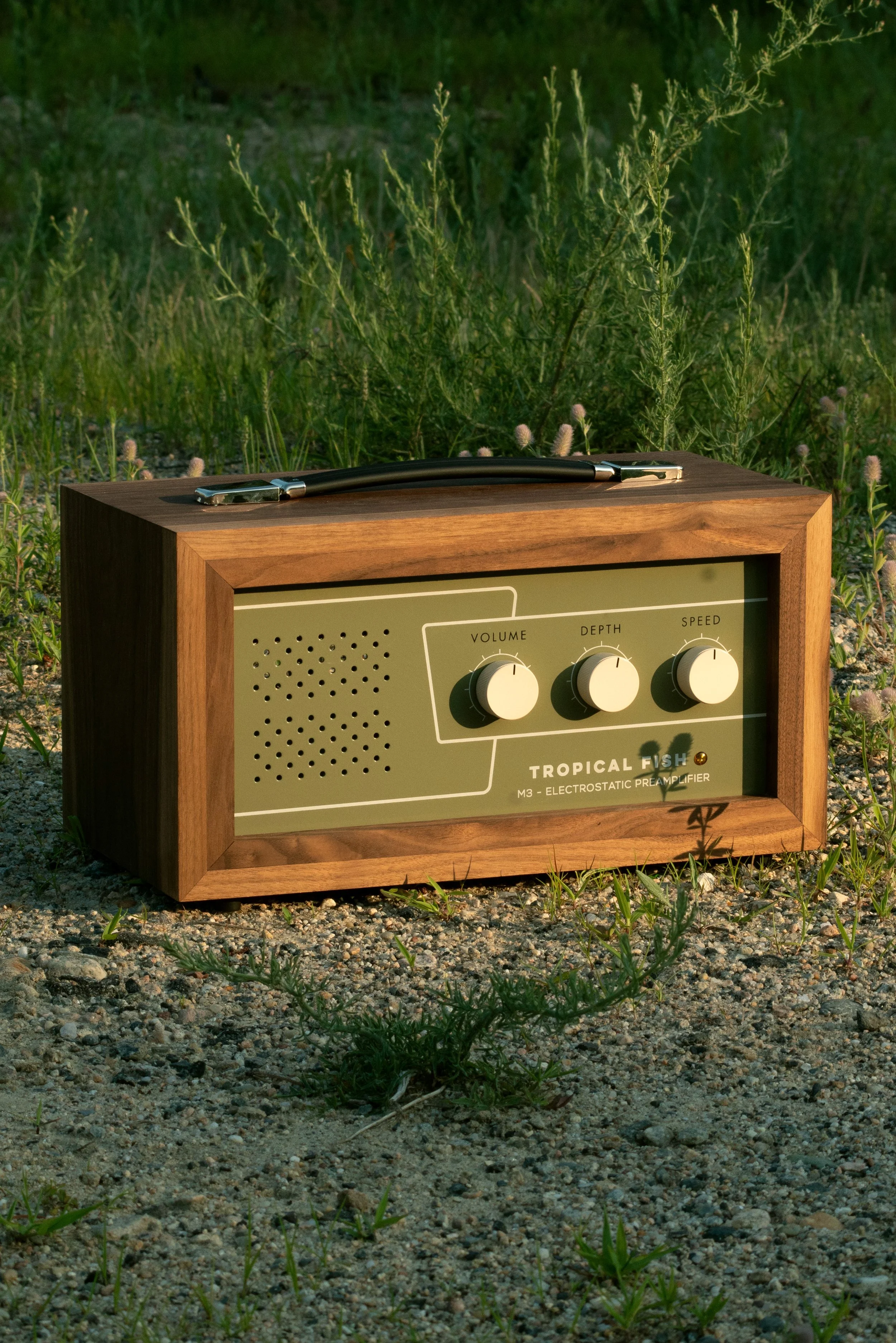
Walnut cabinet
We decided to over-build it
We wanted this unit to simply sound as great as it could, because it would undoubtedly be a part of a signal chain eventually. Meaning, it would plug into something else—whether it be a console, an effects pedal, other processing units. So, we wanted it to be a strong link in whatever chain it ended up being a part of.
Some steps we took that are otherwise considered optional is making sure all coupling capacitors were polypropylene, which beefed up the output coupling cap to a massive size. We also included a choke transformer which significantly upped the filtering in the amp without bringing the supply voltage down.
The enhanced tremolo circuit
One of my favorite features is the super unique switchable tremolo channels. But, to back up, the tremolo portion of the circuit in our preamp resides outside the signal path, and affects the signal optically, so it is completely separated. When you turn the depth all the way off, it is like the tremolo is not there at all. Now, back to the switchable tremolo. Tube tremolo is usually associated with a limited range of speed. So our designer, Paulina, came up with an extremely clever solution. Two sets of discrete tremolo circuits, one geared for slower speeds, and one geared for higher speeds. Both are controllable by the main speed knob. The two speed range can be switched between to your hearts content, with a silent (no pops!) switch.
To be honest, we believed this in theory would work silently, because the tremolo circuit is separate from the rest of the circuit, but we didn’t know for sure until we tried it. So we built the circuit, hooked up the tremolo switch and the results were beautiful. Two channels of tremolo ranges to choose from, and a range within each of those. ‘Very-slow-to-medium’, and ‘medium-to-fast’. Completely silent switching between the two ranges of tremolo speeds. And the added bonus is that you get kind of an iconic Leslie / organ effect when you switch from low to high while playing (because Leslies famously had two set speeds of tremolo).
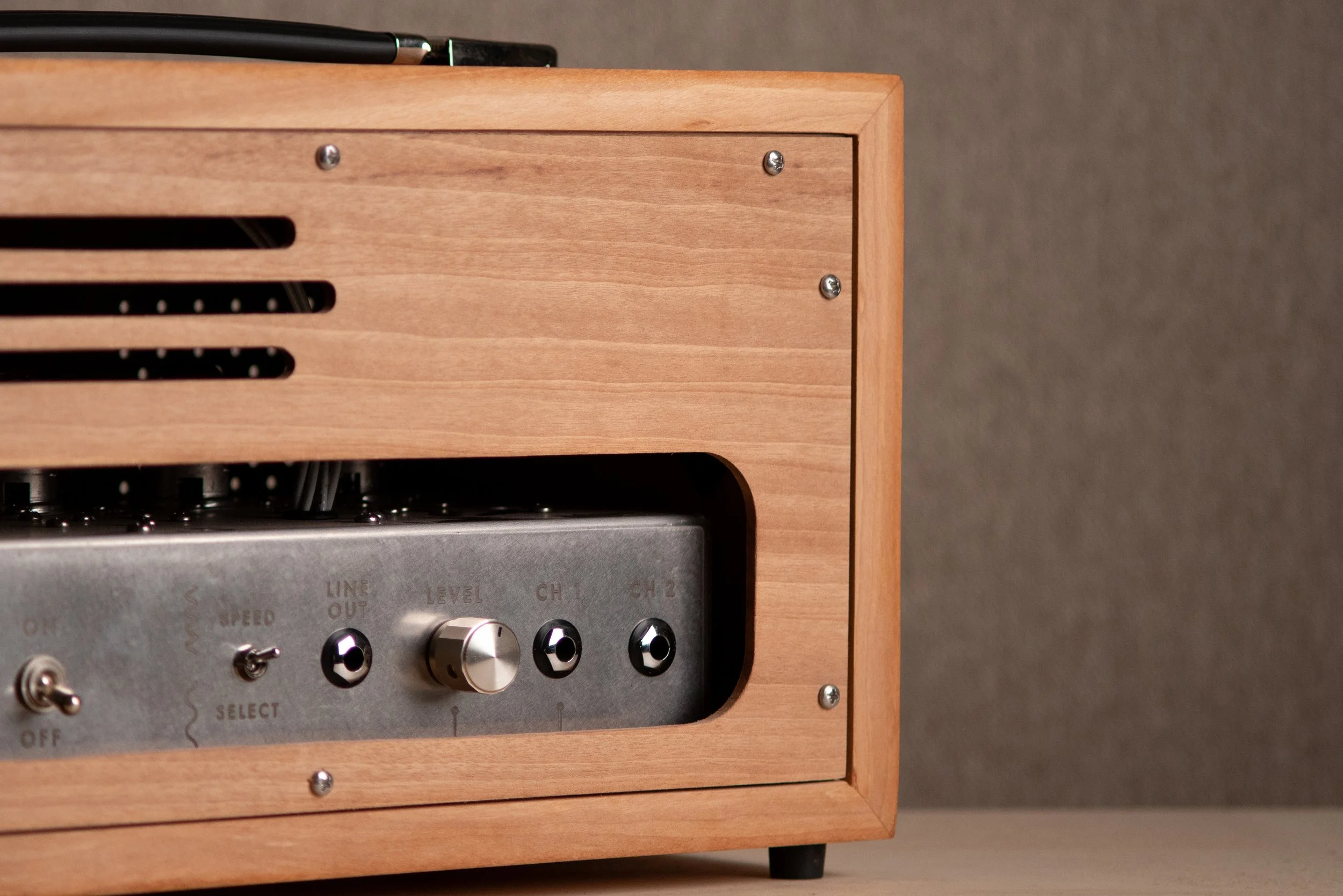
Rear of the M3 preamp, showing the speed switch, output, Level pot and two channel inputs
Using two channels
The final plus (that i’ve identified so far) is the two channels. Having two channels that act differently is great in and of itself. But the channels work well simultaneously too. Something I have learned recently creating short clips of music for my social media accounts using a drum machine and a keyboard (both miked together (I know, strange)) is that summing sounds together gives them a fun and very apparent cohesiveness. I have been using the preamp channels to get both my drum machine and a Wurlitzer keyboard or guitar into one external amp, and miking that. The results have been gelled music.
Also, one channel on the back (CH 1) has a level control. Meaning the channel with the additional control can be driven to add tube distortion. The second channel (CH 2), without the level control, is preset to be clean.
So, in summary, I would call this a great-sounding, very well-built, all-tube, table-top or amp-top preamp with flexible tremolo. Since we have had one around for years, I have already found it to be an indispensable studio tool.
To learn more about preamp’s specs and what our current availability is, visit the product pages here.