
What a Wurlitzer’s Appearance Can Tell You About Its Condition
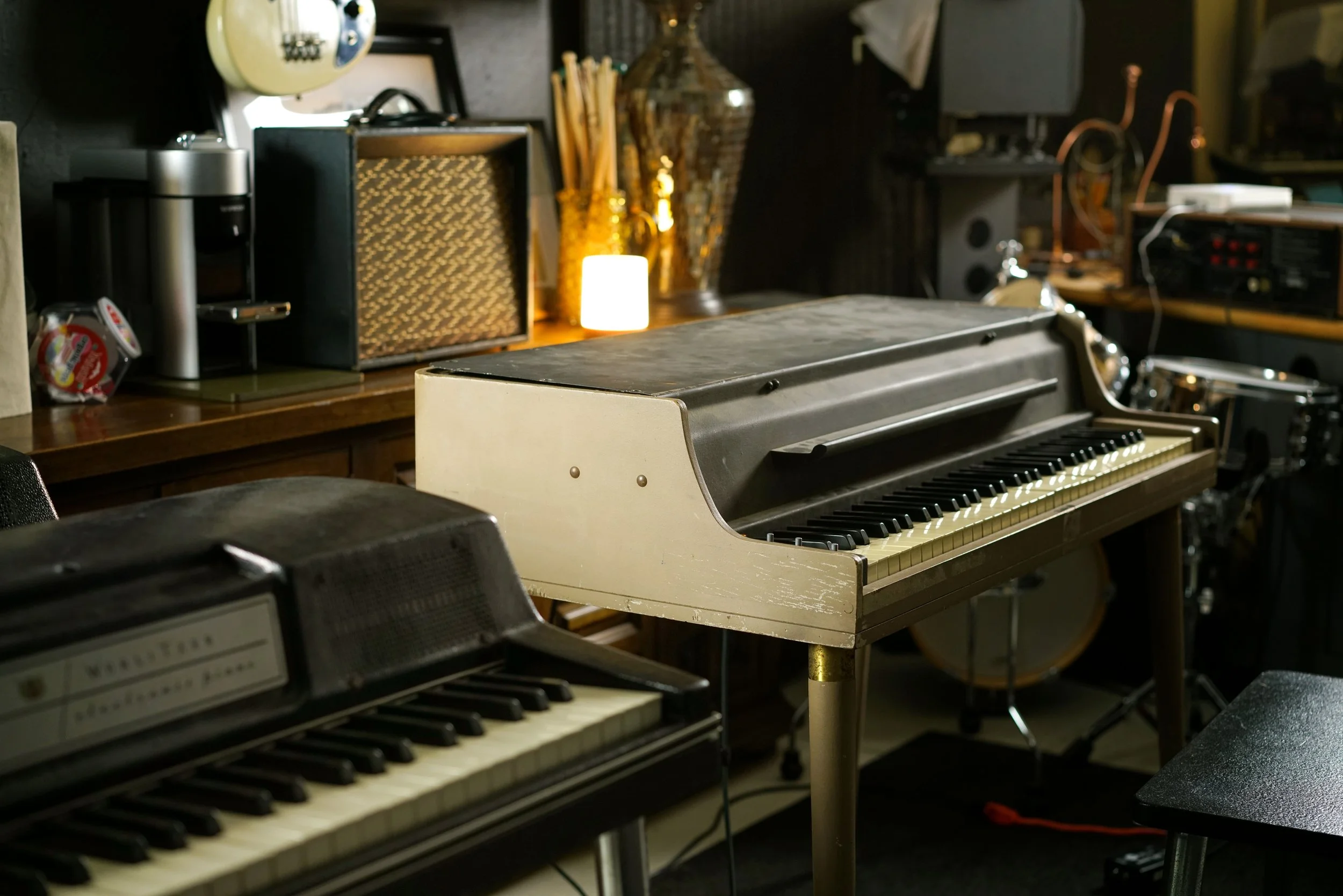
One difficulty of buying a Wurlitzer from a private seller is that you have limited opportunity to examine the keyboard thoroughly. In most cases, you are making the decision based on a handful of photographs. Fortunately, the keyboard’s exterior condition can tell you a lot about how it was stored and whether it is likely to have serious structural problems.
What should you look for when buying a vintage Wurlitzer?
Most problems in a Wurlitzer can be repaired. In fact, some issues are even desirable, because they reduce the cost of the keyboard without increasing the work required to improve playability. For instance, if you already planned to replace key bushings, finding a Wurlitzer with extremely deteriorated bushing felt gives you the ability to negotiate on asking price without adding to your workload.
However, when you choose a vintage keyboard, you should take care to avoid a few extremely rare issues that will add complexity to a restoration. The two most important issues are environmental damage and impact damage. Environmental damage most often occurs when the keyboard has been stored in an extremely humid area or one with extreme temperature swings. Impact damage is sometimes evident in keyboards that have a history of extensive use, or were perhaps stored improperly.
Environmental and impact damage adds a lot of complexity to a restoration, because it could irreversibly compromise unobtainable interior parts. Unfortunately, it is difficult to check for this type of damage if you are buying a keyboard from a private seller. Thoroughly checking internal condition requires partially disassembling the keyboard, which a seller may be unwilling to do. Although you can ask, sellers may find the request annoying and become less likely to negotiate with you on price.
However, in our experience buying vintage keyboards, we’ve learned that the keyboard’s external condition is a major indicator of its internal condition. Cosmetic condition is not just aesthetic. It can give you a lot of information about how the keyboard was stored and used over the years. Examining photos of the exterior can give you the confidence to buy a Wurlitzer whose internal condition is unknown—potentially saving you a lot of money.
How to evaluate a Wurlitzer’s exterior condition
First of all, if you are paying mid-to-high market price for a keyboard, you can and should ask for photos of the interior, or a chance to open up the lid and inspect it for yourself. The following tips are provided to mitigate risk when buying a keyboard at the low end of market value, where it is not possible to inspect its interior condition.
If you are getting a screaming deal on the keyboard, you are pricing in the risk that the keyboard may have problems that you did not foresee. Sometimes you will be pleasantly surprised; other times you may have signed yourself up for a lot of extra work. (This is why we advise studying the market and pricing an escape hatch into your budget.) This is simply the thrill of buying vintage electronic instruments.
Examine the photos in the listing and ask yourself the following questions. The questions assume that you are looking at a 200 or a 200A, but the basic idea is true for any model of Wurlitzer.
Is the lid in good condition? Does it have cracks? Is it scratched up? Is it faded from the sun?
Is the wood cabinet/key base in good condition? Are there scratches and dings? Is the paint still substantially present?
Are the keys in good shape? Do they have hairline cracks? Are they yellow?
Are the legs, hinges, and other metal parts covered in rust?
Is the keyboard extremely dirty?
Do the photos suggest that the keyboard was stored in a semi-outdoor space like a shed or garage? Or do the photos suggest that it was stored indoors, in a climate-controlled room?
Are the keys relatively level? Or do they kind of look like a tumbledown picket fence?
In general, a keyboard that was stored indoors and subject to light use will have excellent cosmetics. If the key tops and metal parts are bright and shiny, if the paint is substantially present, and if the keyboard is largely free from scratches and dings, it is probably going to look excellent inside as well. A keyboard with good cosmetics should be considered an instant buy if you are lucky enough to buy one at a low market price.
Extensive dents and scratches can indicate impact damage. Because the interior parts are wood, it is often possible to repair cracked structural elements using wood glue and clamping. We do this often in our own restorations. However, the price should reflect this issue, because it does add time and complexity to the repair. Some parts, like the key frame, are not available and would need to be fabricated if they are broken.
→ Bonus check: do the legs screw in correctly? If the keyboard has been dropped or knocked over, the stability of the leg or leg plates may be compromised. If the listing includes legs, examine how they are installed. If the legs have a rickety or floppy appearance, the screw connections might be damaged or stripped, which requires remediation.
Rust or a dried-out, discolored appearance can indicate environmental issues. If the keyboard has rust on the outside, it may have rust on the inside as well. Rust on the reeds can affect tone and sustain, and rust on key posts or capstans can affect feel. In all cases, these are complicated repairs. If you see rust on the outside of the keyboard, you must check the inside for moisture damage—unless, of course, you are buying the Wurlitzer at a price so low that the specter of time-consuming repair does not bother you.
Keys that are not perfectly level are expected, but a key level that undulates like a pleasant day at sea deserves examination. This can indicate something wrong with the key frame, key posts, or front and back rail felt.
Problems that are not serious
Hairline cracks in the key tops are a known problem in some Wurlitzer models and are purely cosmetic. However, it is possible but unconfirmed that the cracks occur due to poor storage, so take care to check the inside if possible.
Yellow key tops and faded plastic indicates that the keyboard was stored in direct sunlight. If stored in direct sunlight in a climate-controlled space, these issues are purely cosmetic. But if it bothers you, key tops can be polished to their original color, and a plastic lid can be painted if desired. Both procedures are time-consuming and/or expensive, so the keyboard's sale price should leave room for such interventions.
Dirt and grime is not, in itself, a red flag. The textured lid of the Wurlitzer is somewhat hard to clean, so it is possible that dust just collected in the grooves over years of climate-controlled indoor storage and nobody ever scrubbed it away. However, grime combined with extensive scratches or rust is cause for concern.
Should I be worried that a clean keyboard may be hiding serious internal damage?
Although it sounds plausible that a seller might clean up the keyboard’s external parts in order to fool buyers into thinking that its condition is better than it actually is, this doesn’t actually happen. It is simply too difficult to genuinely disguise the effects of poor storage or serious deterioration.
First of all, cleaning a Wurlitzer requires a fair amount of skill and judgment. Certain cleaning products and techniques are more or less effective than others, and most people just aren't aware of all the nuances involved in cleaning vintage paints and plastics. The seller may rightfully wipe down the keyboard with a little mild detergent, but that's not going to magically improve corrosion and mildew. Remediating those things is essentially restoration in itself, and the question becomes whether a restoration that is mostly cosmetic warrants the asking price. That depends on a whole different set of factors.
Second, most sellers simply do not want to put the effort into deep-cleaning a keyboard. The used instrument market in general does not privilege perfectly clean cosmetics, so there is very little financial incentive to do so. It is possible to replace the original faceplate with a reproduction, and this may increase the resale value if the original was missing or deteriorated—but that's because buyers like shiny fresh faceplates, not because a nice faceplate suggests anything in particular about the interior condition of a keyboard. A seller who installs a new faceplate or new chrome legs is adding value to the keyboard.
So, even accounting for a seller who replaces cosmetic parts or cleans up the keyboard's exterior, there should be enough clues that will indicate a keyboard's prior storage conditions and use. Briefly playing the keyboard should tell you enough to make an informed offer.
And, although you should certainly be observant and apply your judgment wisely, treating every seller as an adversary overcomplicates the transaction. Complicated transactions are expensive transactions. When you are familiar with the item that you are buying, you do not have to depend on the seller’s perfectly angelic conduct in order not to lose your shirt. In these cases, you can approach the transaction with a certain ease and lightness, which can make your offer more attractive to the seller.
How to look for evidence of moisture damage inside the keyboard
Moisture damage is a serious problem that adds complexity to a restoration. It is very important to store a Wurlitzer in a room that does not have extreme moisture or temperature swings, because the mechanical action is full of unfinished wooden parts that readily absorb atmospheric moisture. Moisture damage also tends to give the keyboard a persistent mildew smell. Tips for remediating moisture damage are outside the scope of this article. But, if you need help, ask the Wurly Hotline.
→ Helpful hint: your Wurlitzer will likely smell a lot like the place you bought it from. Unfortunately, confronting someone face-to-face about the overpowering mildew odor of their basement or outbuilding is too awkward even for us to contemplate. For this reason, it is really important to look at the photos and make your best guess about how the place smells before you arrive, and negotiate your price accordingly.
The presence or absence of moisture damage should be fairly obvious if you can remove the lid and access the keys and key bed. You are mostly evaluating the color of the wood.
A light tan color indicates excellent storage. This is characteristic of original-owner keyboards and some exceptional examples of student model keyboards.
Many Wurlitzers will have a medium or golden brown tone. This is normal and acceptable.
Dark-toned wood indicates moisture damage. Very dark or blotchy tones indicate more severe damage.
Additionally, check metal parts for rust and corrosion. You do not want to see extensive rust on reeds, because that can indicate tonal issues. Reeds can be replaced in 200-series or "A" or "B" 140-series models, but it is prohibitively expensive to replace the entire set. Reeds in other models are unavailable. However, if you are interested in potentially being part of the manufacture of new 112, 120/700 or 140/145/720 reeds, join our list here.
Rust on key posts is also a serious problem. Light corrosion can be cleaned, but red-brown rust usually indicates that chrome is being eaten, exposing the metal beneath. The key posts are chrome plated in order to promote smooth key motion. Once that has deteriorated, smooth key travel is no longer guaranteed, and if you replace the key bushings the rust could damage the new felt. It is possible to replace rusty key posts, but it is a fairly involved job. (We can help via the Wurly Hotline.)
Note that flaky white or green corrosion deposits on certain metal parts is common and can happen even under mild environmental conditions. You will often see this on screws and metal supports, while the reeds remain clean. Because the dust may be toxic, do not brush it off and allow it to become airborne. Wipe it with a damp cloth instead.
How to remove a Wurlitzer's lid
Detailed instructions for removing a Wurlitzer's lid can be found here. Note that the keyboard should be unplugged from the wall outlet for this inspection. In many models, removing the lid can expose you to terminals carrying mains voltage.
In Wurlitzer 112, 120/700, and 140-series, you will only need to do minor disassembly to evaluate the keyboard's action parts. This is because removing the lid will immediately expose the dampers and the keys. If these parts look good, the keyboard was likely stored in favorable environmental conditions.
To double-check, gently lift some of the dampers, and you can examine the harp and the hammers. Checking the key bed is also a good idea, and can indicate whether anything was spilled. Remove a handful of keys to find out. The wood underneath should be fairly clean, and felt should not look dried-out or discolored.
It is more difficult to examine a 200-series Wurlitzer. Once you remove the lid, the hammers are covered by the hum shield, and the keys are covered by the amp rail. The 200A has the additional complication of the speakers, which are mounted to the lid and connected to the amp rail via the speaker wires.
If you don't have much time, you can remove the lid and prop it on the left side of the keyboard without disconnecting the speaker connections. Then, try to peek around the amp rail and hum shield and evaluate the overall color of the wood as best as you can. Or, see our guide on how to disassemble a 200-series Wurlitzer.
How to look for impact damage
Dropping your Wurlitzer is obviously not good and can cause problems. If structural wooden parts crack, the playability of the instrument is compromised, which makes full restoration difficult to accomplish. Most wooden parts are not reproduced, so availability depends on whether it is possible to buy parts harvested from other keyboards. However, it is often possible to glue cracked wooden parts back together using woodworking techniques. (Ask us if you need help.)
To determine if a keyboard has suffered unremediated impact damage, the first thing to check is whether all keys play and make sound. It is very normal for keys to feel sticky or inconsistent, or for notes to sound dull. When we restore a keyboard, we tend to replace a lot of the felt as a matter of routine, because that gives the keyboard the most consistent feel and the highest level of playability. A handful of keys that are sticky across all registers is not a cause for concern, and should be addressed with new felt.
However, cracked structural parts can also cause sticky keys. It is difficult to tell the difference between isolated routine playability flaws and serious structural flaws, because the symptoms of both are similar. There are two things to keep in mind:
Impact damage is extremely rare. It is most likely to occur when moving the keyboard from one place to another. Most people do not have a lot of opportunities to drop their Wurlitzer simply because they do not tour or transport their keyboards very often.
If many adjacent keys are sticky or feel weird, there is a high likelihood of some structural flaw in the keyboard. If the keyboard is not priced at bargain-basement levels, you should insist on opening up the lid and checking out the key bed.
More on evaluating a Wurlitzer that you cannot inspect in person
For more information on how photos can help you understand the overall condition of a Wurlitzer, see our article here.
For information on some of the different types of Wurlitzers we've encountered, check out our Field Guide.