
Special Instrument Projects
In addition to Rhodes and Wurlitzer repair, we take on a certain number of special instrument projects annually.
Our favorite projects involve interesting keyboards and flawed tube amplifiers that would benefit from substantial rebuilding.
Our approach to restoration
We prioritize tone and functionality over strict historical originality. We love the original sounds and designs of unique instruments, and our restorations seek to make them highly playable and ready for the recording studio.
We preserve the quirks that make each instrument unique. Those sounds and behaviors are essential when building a toolbox of cool sounds in the studio. But we’ll also upgrade components, electronic circuits, and mechanical assemblies as needed when doing so makes an instrument more responsive to the player or easier to record.
When rebuilding amplifiers, we study the original circuit topology in order to imagine what its designers wanted to accomplish. What aspects of the circuit are intentional design choices? Which were compromises to keep costs down? And which ones simply reflected the limitations of available technology at the time?
The answers inform our approach to restoration. We aim to preserve what the instrument was trying to do while taking advantage of more than sixty years of advances in electronic technology.
What we work on
We work on vintage electronic keyboards, early electronic instruments, and related amplification equipment. We love early synthesizers, electronic pianos, tube amplifiers, drum machines, carillons and chimes. We don’t take on tonewheel organ restorations, but we are always excited to encounter their smaller (often under-appreciated) cousins.
Tube-based tone generators, pitch-shifting vibrato, and unconventional oscillator circuits are a plus. We love seeing odd and idiosyncratic ways of producing new sounds and effects—particularly in the 1950s and 1960s, when technology hadn’t exactly caught up to designers’ ambitions.
Our favorite gear is the stuff that was discontinued because it was no longer considered simple, cheap, or efficient. Sometimes what makes an instrument commercially obsolete is exactly what makes us want to play and record it.
As a small, independent workshop, we have the ability to revisit older designs and give them the individual attention that mass production couldn’t justify. In the end, we have a one-of-a-kind instrument that is both vintage and new, tailored to the needs of the musicians who will use it.
Inquire
Tell us about your project. Please go into as much detail as you’d like about your instrument, its condition, and what you’d like its restoration to accomplish.
Photos are optional, but if you have any handy, we’d love to see them.
Because each project is different, we prepare estimates individually. These are often extensive restorations involving custom engineering and fabrication.
Selected projects
Selmer Clavioline
The Clavioline is an early tube synthesizer that was intended to be mounted under a piano. Its matching power amplifier was designed to provide some harmonic distortion to the audio signal, which is created inside the keyboard by electronic oscillators.
We tuned and adjusted the mechanical action so that the keyboard and its switches were as responsive as possible. We also fully rebuilt the tube amplifier in a new chassis, choosing powder-coated steel to match the old one. This allowed greater potential for reducing the original noise floor and adding small mods that generally improve reliability in a tube amplifier. A major consideration for the redesign was the ability to accommodate both the original harness connections as well as a dedicated instrument input. That way, the unique parallel single-ended amplifier topology could be used with guitar or other keyboards in the studio.
Whippany melo-sonic / realistic musideck
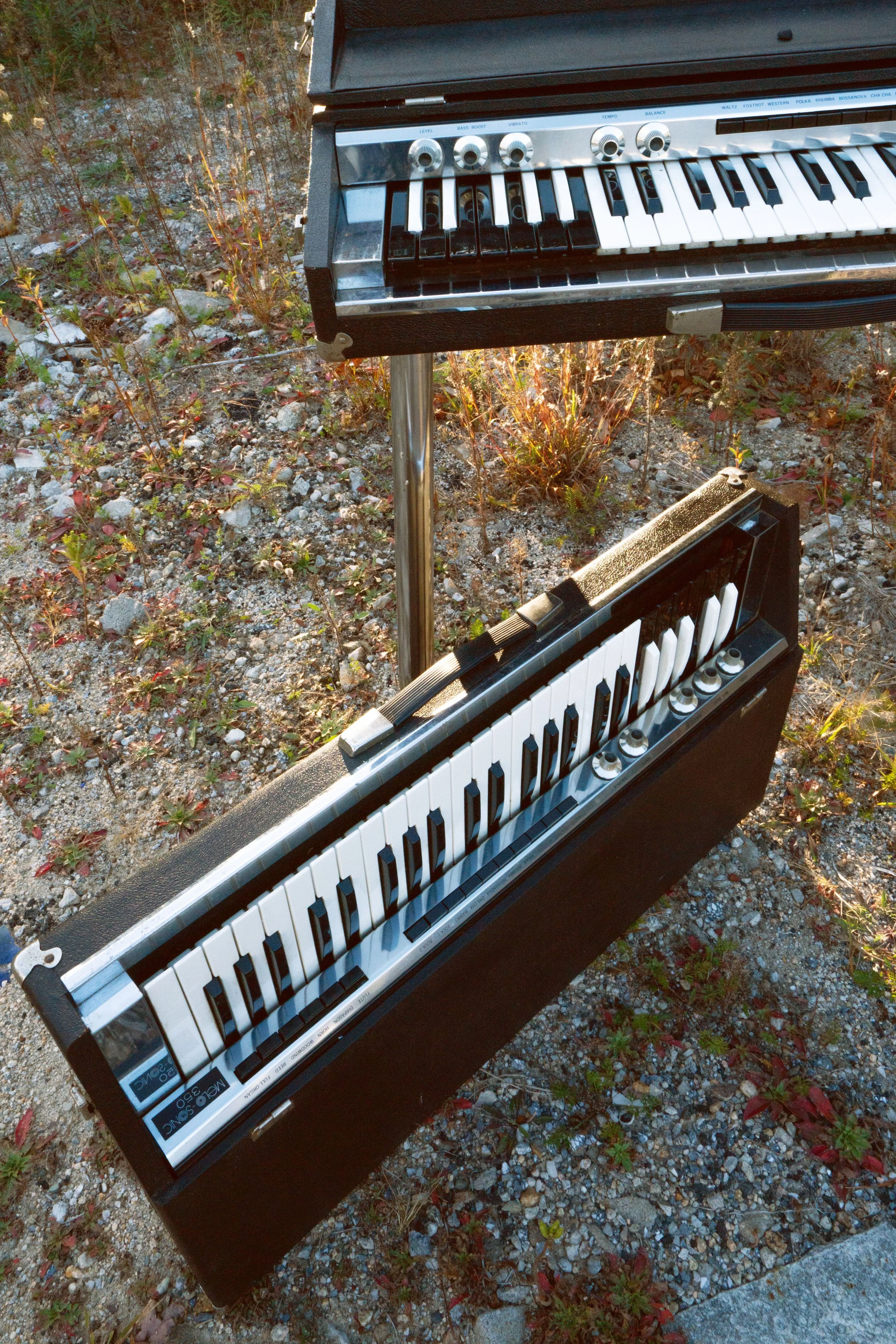
The Whippany Melo-Sonic (also sold under other brand names such as Realistic Musideck) was a lightweight, low-cost combo organ manufactured in the 1960s.
Although it is not fully polyphonic and its contacts are finicky, we have a lot of respect for the compactness of its design and the presence of its tone. Intonation depends on unlabeled precision resistors, so we replace them one by one, calibrating each note individually.
Enunciator cabinet amplifier head
An old hallway speaker cabinet is a very cool thing, especially when it has been painted multiple times over decades. But the original speaker is usually well under 10 watts, and you may not have any reason to mount a cabinet near the ceiling.
We love giving old speaker and amplifier cabinets a second life. In this one, we installed a single-ended 6L6 amplifier head with a guitar input, volume and tone controls and an 8 Ω speaker output.